Rebalancer (forked from Jack Vanlightly and improved)
Create Kafka style consumer groups in other technologies. Rebalancer was born of the need for consumer groups with RabbitMQ. But Rebalancer is completely technology-agnostic and will balance activity over any group of resources across a group of participating nodes.
-
Create Kafka-like "consumer groups" with messaging technologies like RabbitMQ, SQS, etc.
-
Consume a group of resources such as file shares, FTPs, S3 buckets between the instances of a scaled-out application.
-
Single Active-Consumer / Active-Backup
-
Create an application cluster that consumes a single resource in a highly available manner. The cluster leader ( Coordinator) consumes the single resource, and the slaves (Followers) remain idle in backup in case the leader dies.
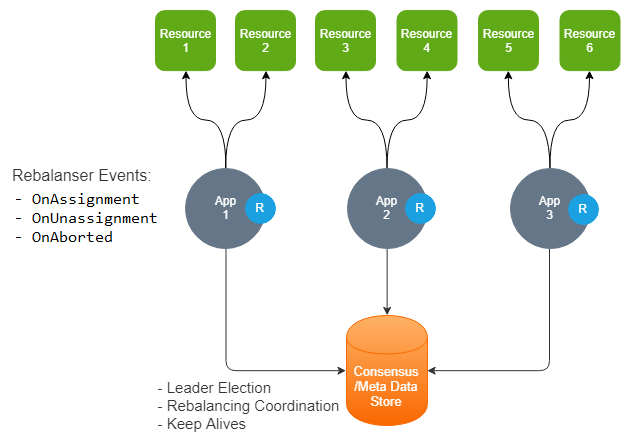
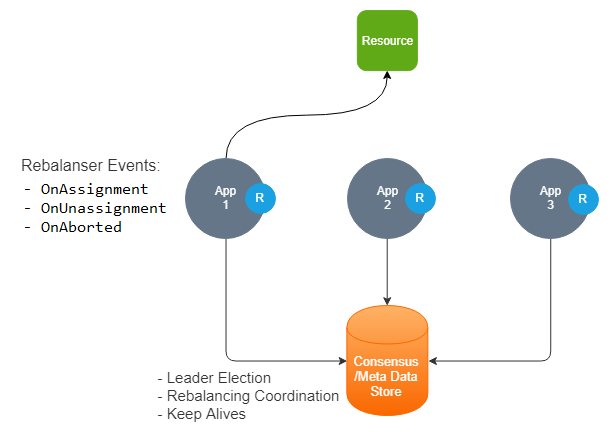
Rebalancer consists of (or will consist of when complete):
-
a set of protocols for different resource allocation algorithms
-
a set of TLA+ specifications that verify the protocols
-
a set of code libraries for multiple languages and backends
The important terms are:
- Resource Group = Group of Nodes + Group of Resources
When a node becomes active, it notifies the other nodes. One node is the Coordinator (leader) and the rest are Followers . The Coordinator has the job to assign resources to nodes. It monitors the coming and going of nodes, as well as changes to the number of resources available to the resource group. When any change happens to the nodes or resources, then the Coordinator triggers a rebalancing.
Different rebalancing algorithms exist:
- Leader-based resource barrier
- Leader-based global barrier
The rebalancing algorithm depends on the backend. With an RDBMS we use the following:
With an RDBMS we use the global barrier algorithm where:
-
The Coordinator orders all Followers to stop activity.
-
Once activity has stopped, the Coordinator distributes the resource identifiers equally between the Followers and itself.
-
The final step is that the Coordinator notifies each Follower of the resources it has been assigned and can start its activity (consuming, reading, writing, etc.).
Other backends are suited to either.
Leader election determines who the Coordinator is. If the Coordinator dies, then a Follower takes its place. Leader election and metadata storage are performed via a consensus service (ZooKeeper, Etcd, Consul, Redis) or an RDBMS with serializable transaction support (SQL Server, Oracle, PostgreSQL). All communication between nodes is also performed via this backing metadata store.
Rebalancer is a suite of code libraries. It must be implemented in your language to use it. Also, different backends will be available.
- Traceability matrix — ADRs, user stories, and paths under
src/,examples/, andtests/ - Product baseline (.NET) — scope, non-goals, v2 themes
- Architecture overview — component diagram
- Architectural decision records —
docs/adrs/ - User stories —
docs/user-stories/
.agents/AGENTS.md— canonical instructions for all agents; rootAGENTS.mdand vendor adapters defer to it.docs/initial-product-specs/README.md— start here for spec-first product work.docs/cogov-a-sdlc/README.md— overview of the co-governed SDLC layout (single vs. multi-repo,docs/artifacts).
Reference Rebalancer.Extensions.DependencyInjection and register the backend you use, for example:
var services = new ServiceCollection();
services.AddRebalancerSqlServer(connectionString);
await using var provider = services.BuildServiceProvider();
var client = provider.GetRequiredService<RebalancerClient>();
Alternatively use AddRebalancerRedis, AddRebalancerZooKeeper, or AddRebalancerProvider(_ => new MyProvider(...)).
The parameterless RebalancerClient constructor still uses static
Providers.Register (ADR 0005).
- Solution: Rebalancer.slnx
tests/Rebalancer.UnitTests— DI registration tests (no Docker).tests/Rebalancer.IntegrationTests— Redis/SQL Server tests use Testcontainers (Docker; tests skip if unavailable). ZooKeeper barrier tests live underZooKeeper/and require a running ZooKeeper cluster (seetests/Rebalancer.IntegrationTests/ZooKeeper/Helpers/ZkHelper.cs).
| Folder | Contents |
|---|---|
src/ |
Library projects (Rebalancer.Core, backends, Rebalancer.Extensions.DependencyInjection). |
examples/ |
Sample host and CLI tools (Rebalancer.RabbitMq.ExampleWithSqlServerBackend, Rebalancer.RabbitMq.Tools). |
tests/ |
Rebalancer.UnitTests, Rebalancer.IntegrationTests. |