


Ring (Circular or Round-Robin) queue-like container with fixed memory footprint.
This brings great memories of decades ago when I worked in a high-tech European company writing telecommunications firmware. Back then C was a luxury and we had to mix C with Assembly to meet memory space (RAM & ROM) and timing requirements. We used a Round-Robin buffer in some part. Later, for fun, I spiced up the round-robin code with some features similar to what we see in this module.
NOTE: Despite what it says above that it is N commits behind Serge's repo, I have already fixed that here but in a different way. I will have to disconnect the reference because our repositories are quite different.
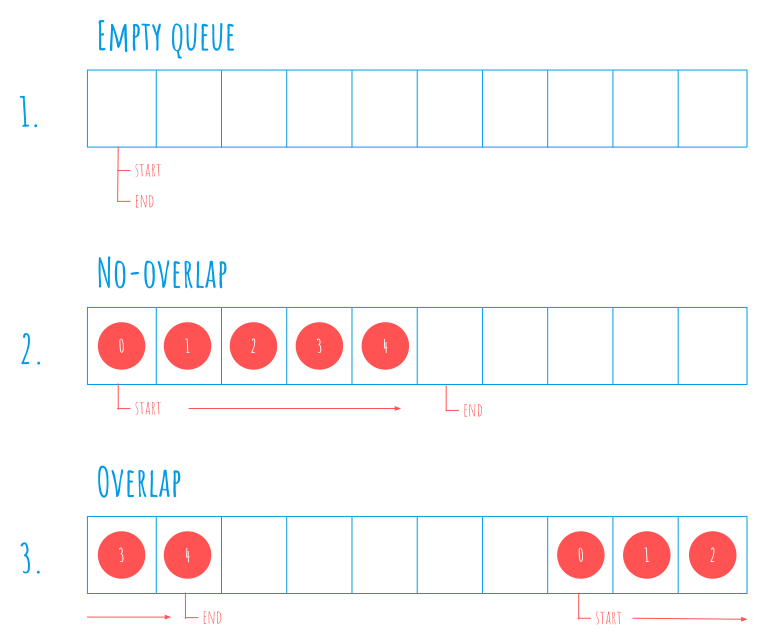
So, what is a Ring Queue and why it's useful:
- It uses a static / fixed array buffer (no costly allocations)
- It does not shift elements on element removal (no costly memcopy)
- It can start anywhere in the buffer and loop over the end
To add it on your module or GO application:
go get https://github.com/lordofscripts/go-roundrobin
Then in your source code:
import "lordofscripts/go-roundrobin"While it has three different implementations, you decide which one is more suitable for your requirements. All three implementations comply with:
	type IRingQueue[T any] interface {
		fmt.Stringer
		io.Closer

		SetPopDeadline(t time.Time) error
		SetWhenFull(a WhenFull) IRingQueue[T]
		SetOnClose(callback OnCloseCallback[T]) IRingQueue[T]

		Size() int
		Cap() int

		Push(element T) (newLen int, err error)
		Pop() (element T, newLen int, err error)
		Peek() (element T, len int, err error)

		Reset()
	}
If you plan to use it with Go Routines, or need to specify onClose actions
and define behaviors for Full and Empty queues, or even set a deadline for
a blocking Pop operation:
	const CAPACITY int = 100
	var intCallback roundrobin.OnCloseCallback[int] = somefunctionOrMethod
	intRingbuffer := roundrobin.NewSafeRingBuffer[int](CAPACITY, WhenFullError, WhenEmptyBlock, intCallback)
	intRingbuffer.SetPopDeadline(time.Now().Add(5 * time.Second))

	charRingbuffer := roundrobin.NewSafeRingBuffer[rune](CAPACITY, WhenFullOverwrite, WhenEmptyError, nil)
If you don't need any of the extra features (full/empty behavior, close callback, thread-safe, etc.):
	const CAPACITY int = 100
	intRingbuffer := roundrobin.NewRingBuffer[int](CAPACITY)
	charRingbuffer := roundrobin.NewRingBuffer[rune](CAPACITY)
And in the remote case you need something suitable for characters/runes whether single or multi-byte, not for concurrent use but with the ability to have a user-defined behavior when the buffer is full:
	const CAPACITY int = 100
	charRingbuffer := roundrobin.NewRuneRingBuffer(CAPACITY).
SetWhenFull(WhenFullOverwrite) // not required!As you may have noticed, this is a forked repository from Serge. I was looking for something like that without the need to redesign the wheel, just improve it.
In this forked version, the original has been enhanced with a slightly different interface IRingQueue. So this
repository is a hybrid between Serge's original, and Haddi's
much improved version that introduced a change in the original signatures and the addition of a "safe" version
that uses a synchronization mechanism.
Serge's wonderful implementation can be
used with the NewRingQueue[T]() constructor. It has these features:
- Safe for single-threaded applications
- Based on generic types
- Benchmarked the differences between a plain array-based ring queue and his generics ring queue.
- Read his full post here: https://www.sergetoro.com/golang-round-robin-queue-from-scratch
Muhammad's repository can be
instantiated with the NewSafeRingQueue[T]() constructor. It brings in great
new features:
- Has a synchronization mechanism making it suitable for go-routines (multi-threaded).
- The user can specify the behavior when
Push()onto a full queue:WhenFullErrororWhenFullOverwrite. - The user can specify the behavior when
Pop()from an empty queue:WhenEmptyErrororWhenEmptyBlock(block until data available). - The user can specify a callback to invoke when the Ring Queue is closed. Once closed
all operations on it will fail. He added this to both his thread-safe version and the
original thread-unsafe version. Additionally he backported the
WhenFullfeature into the original (thread-unsafe) version. - He introduced a generic interface implemented by both the single and multi-threaded versions.
- Given that a
Pop()on an empty queue may block (user-defined), he introduced a user-defined deadline. - Consolidated errors that are globally-defined
- Has a bug in its
Len()method though! which Serge already fixed after I filed an issue. Unfortunately, M. Hadi's repository has disabled issues. - I believe he also has a bug in his Push method that instead checks
whenEmptyrather thanwhenFull, but again, there is no way to report problems with his code.
I needed a ring queue for runes only, and loved the benchmarking. I was curious about the performance differences between Serge's generics version, and a concrete rune version based entirely on his type, but without the generics. Then I discovered Muhammand's great enhancements and decided it would be nice to bring all together but adapted to my needs.
So, I, Lord of Scripts created this hybrid fork. My rune-specific type can
be instantiated with the NewRuneRingQueue() constructor. While I didn't add great
functionality other than adding a new (basic) type for curiosity, I also did this:
- Added tests for different scenarios of
WhenFullandWhenEmpty - Fixed several size issues from both Haddi's & Serge's code that returned the wrong size. I decided to use a thread-safe size counter instead of the unreliable size based on start/end comparisons (that bug remains in both their repos.)
- I renamed the interface to
IRingQueue[T any]and all three objects implement this interface. RuneRingQueueis only suitable for single-threaded applications, like Serge's.- I simplified Muhammed's constructors without compromising functionality (see below).
- I added the
SetWhenFull(WhenFull)fluent API interface method. - I added the
SetOnClose(func OnCloseCallback[T])fluent API interface method. - Added
Reset()which is handy when reusing a buffer of the same size - All sources use a standards template, sorry, it comes from my times working at Software Process Improvement and Standarization.
- Refactored the tests so that they are split into several files depending on who implemented it.
- Parallelized and modernized the Timing tests. Now they use a feature introduced in GO v1.24.
If you are interested, here are some benchmarks we ran on both the original code and the improved code.
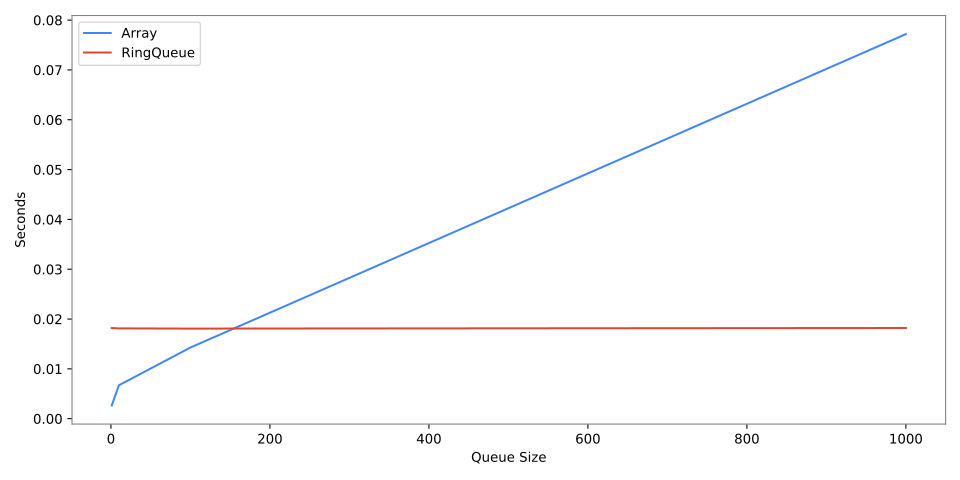
Do you like benchmarks? I love them, even though many cases they are non-exhaustive, relatively synthetic and might give a skewed view of reality :) So, let's see how our implementation performs against a simple Go array. Remember, what we're looking for is an array slow down due to excessive copying.
func BenchmarkRR(b *testing.B) {
	rr := NewRingQueue[int](100_000)

	for n := 0; n < b.N; n++ {
		if rr.IsFull() {
			rr.Pop()
		}
		rr.Push(n)
	}
}

func BenchmarkArray(b *testing.B) {
	var ar [100_000]int
	size := 0

	for n := 0; n < b.N; n++ {
		if size >= 100_000 {
			copy(ar[0:], ar[1:])
			size--
		}

		ar[size] = n
		size++
	}
}
Which one do you thing would be the fastest? 😉 Let's run it!
go test -bench=. -benchmemHere's results on my Intel NUC Ubuntu Linux machine:
goos: linux
goarch: amd64
cpu: Intel(R) Core(TM) i7-10710U CPU @ 1.10GHz
BenchmarkRR-12          59798865                18.50 ns/op
BenchmarkArray-12        1000000             17321.00 ns/op
PASS
If I run the same test with just 10_000 queue size instead of 100_000:
goos: linux
goarch: amd64
cpu: Intel(R) Core(TM) i7-10710U CPU @ 1.10GHz
BenchmarkRR-12          57184480                18.65 ns/op
BenchmarkArray-12        1000000              1068 ns/op
PASS
Let's plot the relation of run times and queue lengths:
And old laptop from 2010 which works quite fine with Linux but it crawls to a halt with Windows 10 after they dumped zillions of bloatware and delayware to force people to buy new computers.
My system is an Intel i5-M430 with 4 cores at 2.27GHz instead of Serge's Intel i7 with 12 cores at 1.10GHz.
The benchmark on the specialized RuneRingQueue which spares
you from the overhead of generics:
goos: linux
goarch: amd64
cpu: Intel(R) Core(TM) i5 CPU       M 430  @ 2.27GHz
BenchmarkRR-4          22,946,761                55.32 ns/op
BenchmarkArray-4        1,000,000              1,068 ns/op
PASS
Whereas the timing tests on a 100K Ring buffer using a plain array, the concrete Rune implementation (no generics) and the generics implementation respectively:
goos: linux
goarch: amd64
cpu: Intel(R) Core(TM) i5 CPU       M 430  @ 2.27GHz
TestSizes_Array        100K elements       116.96s
TestSizes_RuneConcrete 100K elements       0.055031723s
TestSizes_GenericRune  100K elements       0.060474519s
TestSizes_GenericInt   100K elements       0.055532279s
PASS