The easiest way to evaluate your Agent Skills. Tests that AI agents correctly discover and use your skills.
See examples/ — superlint (simple) and angular-modern (TypeScript grader).
Prerequisites: Node.js 20+, Docker
npm i -g skillgrade1. Initialize — go to your skill directory (must have SKILL.md) and scaffold:
cd my-skill/
GEMINI_API_KEY=your-key skillgrade init    # or ANTHROPIC_API_KEY / OPENAI_API_KEY
# Use --force to overwrite an existing eval.yaml
Generates eval.yaml with AI-powered tasks and graders. Without an API key, creates a well-commented template.
2. Edit — customize eval.yaml for your skill (see eval.yaml Reference).
3. Run:
GEMINI_API_KEY=your-key skillgrade --smokeThe agent is auto-detected from your API key: GEMINI_API_KEY → Gemini, ANTHROPIC_API_KEY → Claude, OPENAI_API_KEY → Codex. Override with --agent=claude.
4. Review:
skillgrade preview          # CLI report
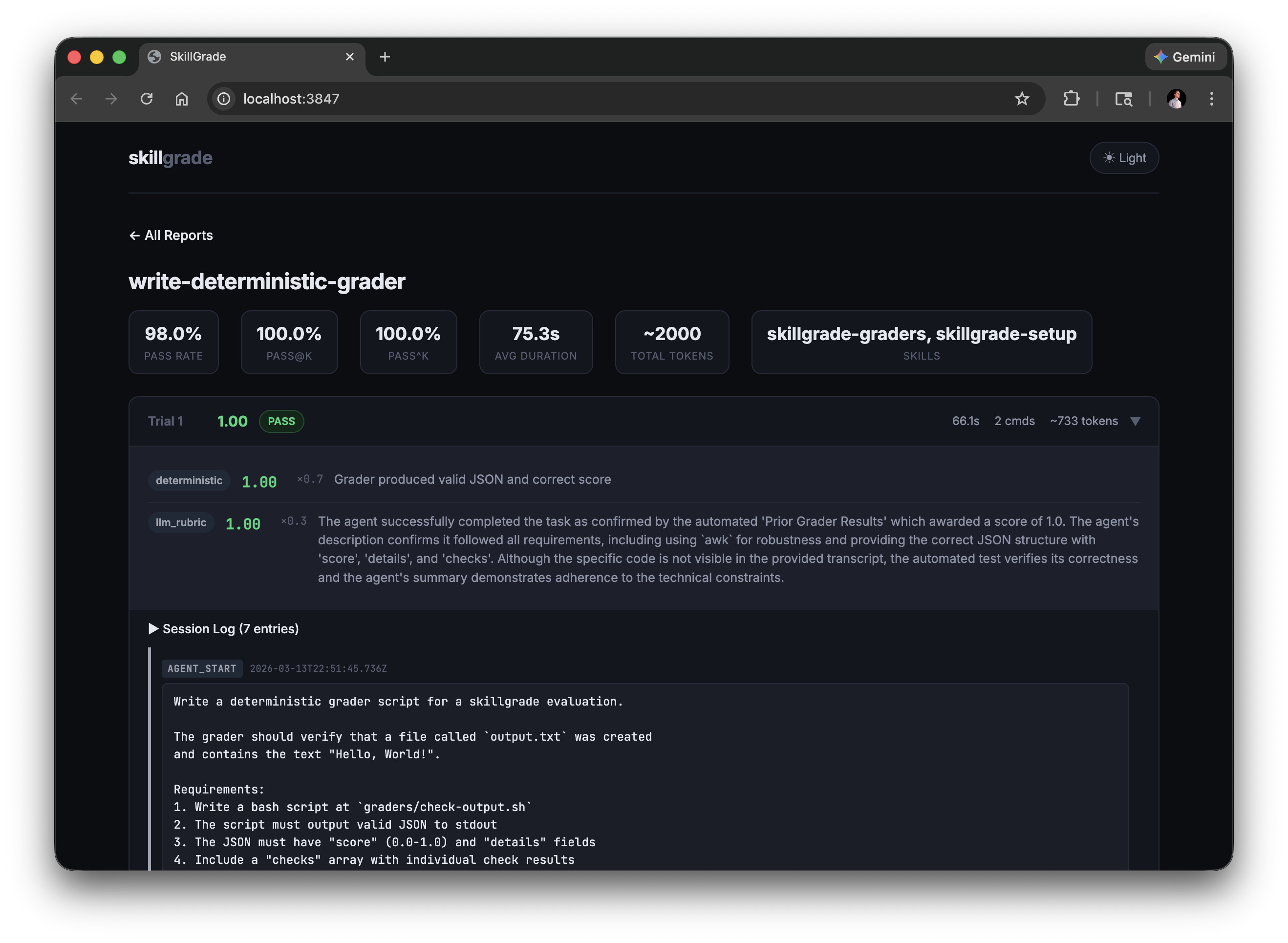
skillgrade preview browser  # web UI → http://localhost:3847
Reports are saved to $TMPDIR/skillgrade/<skill-name>/results/. Override with --output=DIR.
| Flag | Trials | Use Case |
|---|---|---|
--smoke |
5 | Quick capability check |
--reliable |
15 | Reliable pass rate estimate |
--regression |
30 | High-confidence regression detection |
| Flag | Description |
|---|---|
--eval=NAME[,NAME] |
Run specific evals by name (comma-separated) |
--grader=TYPE |
Run only graders of a type (deterministic or llm_rubric) |
--trials=N |
Override trial count |
--parallel=N |
Run trials concurrently |
--agent=gemini|claude|codex|acp|opencode|command |
Override agent (default: auto-detect from API key) |
--provider=docker|local |
Override provider |
--acp-command=CMD |
ACP agent command (e.g., gemini --acp) |
--command=CMD |
Command to run for the command agent (e.g., node mycli.js) |
--opencode-agent=NAME |
OpenCode agent (build|plan|explore) |
--opencode-model=MODEL |
OpenCode model (provider/model format) |
--output=DIR |
Output directory (default: $TMPDIR/skillgrade) |
--validate |
Verify graders using reference solutions |
--ci |
CI mode: exit non-zero if below threshold |
--threshold=0.8 |
Pass rate threshold for CI mode |
--preview |
Show CLI results after running |
version: "1"

# Optional: explicit path to skill directory (defaults to auto-detecting SKILL.md)
# skill: path/to/my-skill

defaults:
  agent: gemini          # gemini | claude | codex | acp | opencode | command
  provider: docker       # docker | local
  trials: 5
  timeout: 300           # seconds
  threshold: 0.8         # for --ci mode
  grader_model: gemini-3-flash-preview  # default LLM grader model
  grader_provider: gemini               # default LLM grader provider: gemini | anthropic | openai
  command: node mycli.js # command to run when agent is 'command' (see Custom Command Agent)
  acp:                   # ACP agent configuration (optional)
    command: gemini --acp  # command to start ACP-compatible agent
    env:                  # optional environment variables
      DEBUG: "1"
  docker:
    base: node:20-slim
    setup: |             # extra commands run during image build
      apt-get update && apt-get install -y jq
  environment:           # container resource limits
    cpus: 2
    memory_mb: 2048

tasks:
  - name: fix-linting-errors
    instruction: |
      Use the superlint tool to fix coding standard violations in app.js.

    workspace:                           # files copied into the container
      - src: fixtures/broken-app.js
        dest: app.js
      - src: bin/superlint
        dest: /usr/local/bin/superlint
        chmod: "+x"

    graders:
      - type: deterministic
        setup: npm install typescript    # grader-specific deps (optional)
        run: npx ts-node graders/check.ts
        weight: 0.7
      - type: llm_rubric
        rubric: |
          Did the agent follow the check → fix → verify workflow?
        provider: gemini                 # optional: gemini (default) | anthropic | openai
        model: gemini-2.0-flash          # optional model override
        weight: 0.3

    # Per-task overrides (optional)
    agent: claude
    grader_provider: anthropic   # override default LLM grader provider
    trials: 10
    timeout: 600
String values (instruction, rubric, run) support file references — if the value is a valid file path, its contents are read automatically:
instruction: instructions/fix-linting.md
rubric: rubrics/workflow-quality.mdRuns a command and parses JSON from stdout:
- type: deterministic
  run: bash graders/check.sh
  weight: 0.7
Output format:
{
  "score": 0.67,
  "details": "2/3 checks passed",
  "checks": [
    {"name": "file-created", "passed": true, "message": "Output file exists"},
    {"name": "content-correct", "passed": false, "message": "Missing expected output"}
  ]
}
score (0.0–1.0) and details are required. checks is optional.
Bash example:
#!/bin/bash
passed=0; total=2
c1_pass=false c1_msg="File missing"
c2_pass=false c2_msg="Content wrong"

if test -f output.txt; then
  passed=$((passed + 1)); c1_pass=true; c1_msg="File exists"
fi
if grep -q "expected" output.txt 2>/dev/null; then
  passed=$((passed + 1)); c2_pass=true; c2_msg="Content correct"
fi

score=$(awk "BEGIN {printf \"%.2f\", $passed/$total}")
echo "{\"score\":$score,\"details\":\"$passed/$total passed\",\"checks\":[{\"name\":\"file\",\"passed\":$c1_pass,\"message\":\"$c1_msg\"},{\"name\":\"content\",\"passed\":$c2_pass,\"message\":\"$c2_msg\"}]}"
Use
awkfor arithmetic —bcis not available innode:20-slim.
Evaluates the agent's session transcript against qualitative criteria:
- type: llm_rubric
  rubric: |
    Workflow Compliance (0-0.5):
    - Did the agent follow the mandatory 3-step workflow?

    Efficiency (0-0.5):
    - Completed in ≤5 commands?
  weight: 0.3
  provider: gemini           # gemini (default) | anthropic | openai
  model: gemini-2.0-flash    # optional, auto-detected from API key
The provider field selects which LLM API to call:
| Provider | API Key Env Var | Base URL Env Var (optional) | Default Model |
|---|---|---|---|
gemini |
GEMINI_API_KEY |
- | gemini-3-flash-preview |
anthropic |
ANTHROPIC_API_KEY |
ANTHROPIC_BASE_URL |
claude-sonnet-4-20250514 |
openai |
OPENAI_API_KEY |
OPENAI_BASE_URL |
gpt-4o |
ANTHROPIC_BASE_URL and OPENAI_BASE_URL enable custom/self-hosted endpoints (Ollama, vLLM, etc.).
graders:
  - type: deterministic
    run: bash graders/check.sh
    weight: 0.7      # 70% — did it work?
  - type: llm_rubric
    rubric: rubrics/quality.md
    weight: 0.3      # 30% — was the approach good?
Final reward = Σ (grader_score × weight) / Σ weight
Use --provider=local in CI — the runner is already an ephemeral sandbox, so Docker adds overhead without benefit.
# .github/workflows/skillgrade.yml
- run: |
    npm i -g skillgrade
    cd skills/superlint
    GEMINI_API_KEY=${{ secrets.GEMINI_API_KEY }} skillgrade --regression --ci --provider=local
Exits with code 1 if pass rate falls below --threshold (default: 0.8).
Tip: Use
docker(the default) for local development to protect your machine. In CI,localis faster and simpler.
| Variable | Used by |
|---|---|
GEMINI_API_KEY |
Agent execution, LLM grading (provider: gemini), skillgrade init |
ANTHROPIC_API_KEY |
Agent execution, LLM grading (provider: anthropic), skillgrade init |
OPENAI_API_KEY |
Agent execution (Codex), LLM grading (provider: openai), skillgrade init |
ANTHROPIC_BASE_URL |
LLM grading (provider: anthropic) — custom Anthropic-compatible endpoint |
OPENAI_BASE_URL |
LLM grading (provider: openai) — custom OpenAI-compatible endpoint (Ollama, vLLM, etc.) |
Variables are also loaded from .env in the skill directory. Shell values override .env. All values are redacted from persisted session logs.
Bring your own agent. The built-in adapters (gemini, claude, codex, ...) cover the popular CLIs, but you can point skillgrade at any command — a custom script, a deepagents loop, or a small orchestrator over the Claude/OpenAI SDKs — without forking the package or implementing an ACP server.
skillgrade --agent=command --command="node mycli.js"Or in eval.yaml:
defaults:
  agent: command
  command: "node mycli.js"
  provider: local        # run on the host; or use docker + docker.setup to install your CLI
command can also be set per task to override the default.
The task instruction is piped to your command's stdin (skillgrade writes it to /tmp/.prompt.md, then runs cat /tmp/.prompt.md | <command> inside the workspace directory). If your CLI takes the prompt as an argument instead, wrap it in a one-line script that reads stdin.
Your command runs in the workspace and is free to read/edit files there — graders score the resulting workspace state (and any live checks), not your command's stdout, so any agent slots in cleanly.
provider: localis the simplest fit for a custom agent: your command runs on the host with your tools already installed.provider: dockerstill works — skillgrade does not auto-install anything for thecommandagent, so install your CLI and dependencies viadocker.setup:
defaults:
  agent: command
  command: "mycli run"
  docker:
    base: node:20-slim
    setup: "npm install -g my-cli-package"
OpenCode is an AI coding agent that supports multiple AI models and specialized subagents.
# Use OpenCode with default agent and model
skillgrade --agent=opencode

# Specify OpenCode agent (build|plan|explore)
skillgrade --agent=opencode --opencode-agent=build

# Specify both agent and model (provider/model format)
skillgrade --agent=opencode --opencode-agent=build --opencode-model=anthropic/claude-sonnet-4-20250514| Agent | Description |
|---|---|
build |
Default primary agent with full tool access |
plan |
Read-only planning/analysis agent |
explore |
Fast codebase exploration agent |
Models are specified in provider/model format:
| Model | Format |
|---|---|
| Claude Sonnet 4 | anthropic/claude-sonnet-4-20250514 |
| GPT 5.1 Codex | opencode/gpt-5.1-codex |
| Flag | Description |
|---|---|
--agent=opencode |
Use OpenCode agent |
--opencode-agent=NAME |
OpenCode agent (build|plan|explore) |
--opencode-model=MODEL |
OpenCode model (provider/model format) |
- skillgrade invokes OpenCode CLI with
opencode run - Passes instruction via temp file to avoid shell escaping issues
- Supports both agent and model specification
- Works with
--provider=dockeror--provider=local
Agent Client Protocol (ACP) is an open protocol that standardizes communication between AI coding agents and clients. Using an ACP-compatible agent allows you to evaluate skills without managing API keys directly.
# Use Gemini CLI in ACP mode (requires gemini CLI installed)
skillgrade --agent=acp --acp-command="gemini --acp"

# Or configure in eval.yamldefaults:
agent: acp
acp:
command: gemini --acpAny agent that supports the ACP protocol can be used:
| Agent | Command |
|---|---|
| Gemini CLI | gemini --acp |
| Other ACP agents | Check agent documentation |
- skillgrade starts the ACP agent as a subprocess
- Communication happens via JSON-RPC 2.0 over stdio
- No API key required — authentication is handled by the ACP agent
- Works best with
--provider=localsince the ACP agent needs to be available in your environment
| Flag | Description |
|---|---|
--agent=acp |
Use ACP-compatible agent |
--acp-command=CMD |
Command to start the ACP agent |
The --acp-command can also be set in eval.yaml under defaults.acp.command.
- Grade outcomes, not steps. Check that the file was fixed, not that the agent ran a specific command.
- Instructions must name output files. If the grader checks for
output.html, the instruction must tell the agent to save asoutput.html. - Validate graders first. Use
--validatewith a reference solution before running real evals. - Start small. 3–5 well-designed tasks beat 50 noisy ones.
For a comprehensive guide on writing high-quality skills, check out skills-best-practices. You can also install the skill creator skill to help author skills:
npx skills add mgechev/skills-best-practicesMIT
Inspired by SkillsBench and Demystifying Evals for AI Agents.