
qFoldIT is a «Universal Builder & Gamifier of Scientific Problems».
Any researcher describes a scientific problem once → the system turns it into a game of any genre → players solve it → results flow back into the scientific graph.


qFoldIT builds the connective tissue between real scientific computation and shared, playable, multiplayer worlds. Its mission is straightforward: take genuine science -- protein folding, quantum simulation, drug screening, industrial process modeling -- and give it a form people can walk through, compete over, and build together, starting with Fortnite and extending across the major game and simulation engines used in research and industry today.
This document covers the full qFoldIT ecosystem: its architecture, its shipped capabilities, and the vision it's built toward.
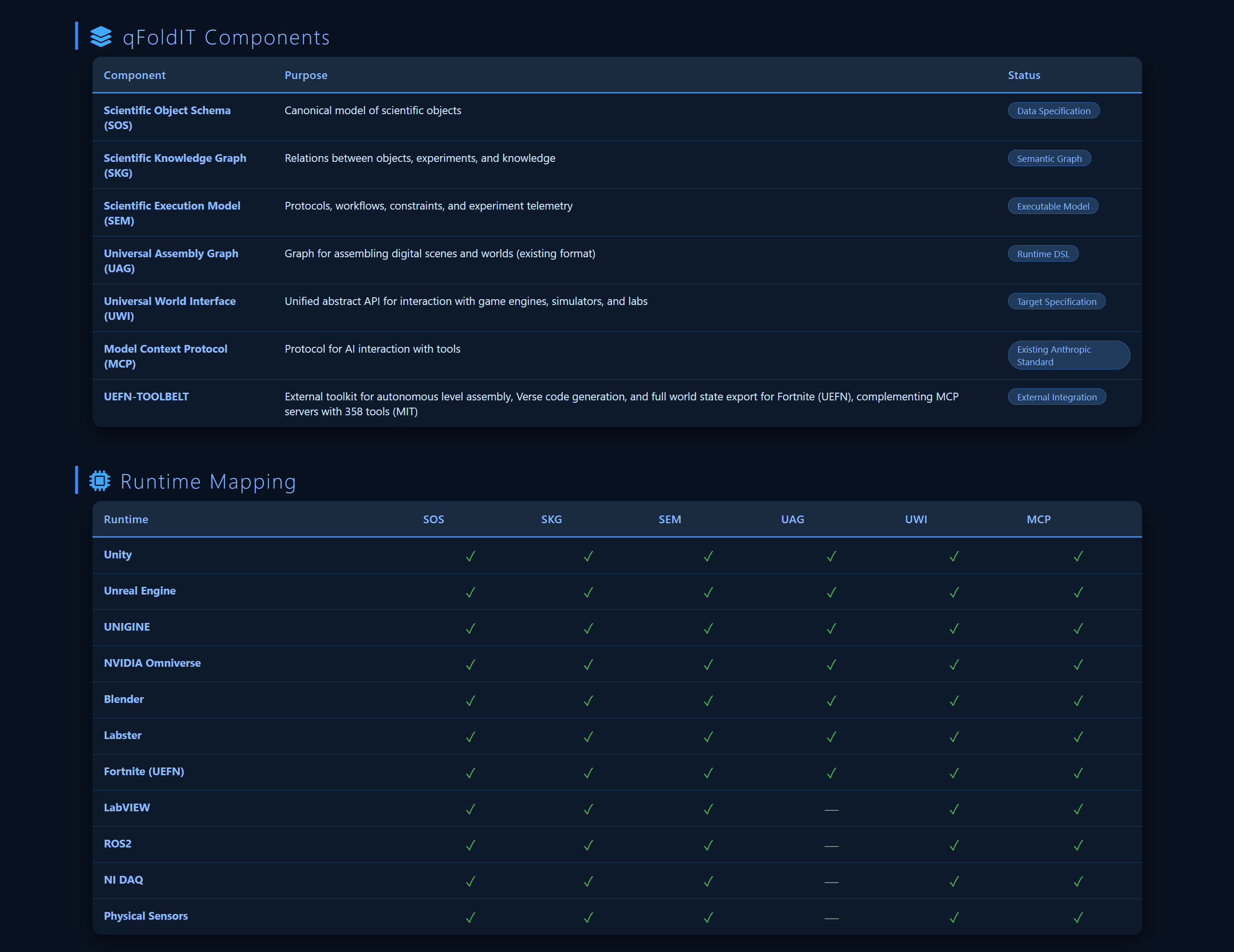
qFoldIT organizes its whole stack into six named layers, each with a clear job:
| Layer | Purpose |
|---|---|
| Scientific Object Schema (SOS) | The canonical data model for scientific objects -- proteins, molecules, materials, reactors, quantum circuits, and more -- shared across every qFoldIT tool and skill. |
| Scientific Knowledge Graph (SKG) | Captures the relationships between objects, experiments, and the knowledge they produce -- the living map of what's been discovered and how it connects. |
| Scientific Execution Model (SEM) | Describes protocols, workflows, constraints, and experiment telemetry -- the executable side of the science, covering who does what and how a run unfolds. |
| Universal Assembly Graph (UAG) | A real, working, engine-neutral scene-graph format already used to describe 3D worlds -- nodes, connections, constraints, and interactions that any supported engine can render. |
| Universal World Interface (UWI) | A translation layer connecting the abstract SOS/SKG/SEM/UAG model to the concrete tool calls of each real game engine's own live bridge -- with working implementations shipping today for Unity, Unreal, UNIGINE, and all three UEFN backends. |
| Model Context Protocol (MCP) | The transport layer, built on Anthropic's open MCP standard, that lets AI agents drive every tool in the stack. |
Alongside these six, UEFN-TOOLBELT (undergroundrap/UEFN-TOOLBELT, AGPL-3.0) is a powerful external toolkit qFoldIT integrates directly for Fortnite: 358 tools for autonomous level assembly, full world-state export, and -- uniquely -- real Verse gameplay-code generation, complementing qFoldIT's own MCP servers.


This layered design is what lets a single scientific result -- a folded protein, a converged quantum simulation, a cleared drug-safety screen -- flow all the way from raw computation to a shared, walkable, competitive experience, on whichever engine a community wants to build in.
qFoldIT's Protein-Design-MCP server puts real computational biology, chemistry, and physics directly in the hands of an AI agent:
- Generative protein design: binder design, fold generation, sequence design and optimization, backbone generation, structure and complex prediction, interface analysis, energy minimization, stability scoring, hotspot suggestion -- built on RFdiffusion, ProteinMPNN, ESMFold, and AlphaFold2.
- Physics-grade refinement: PyRosetta scoring, relaxation, interface scoring, and design, plus Boltz-2 structure and affinity prediction.
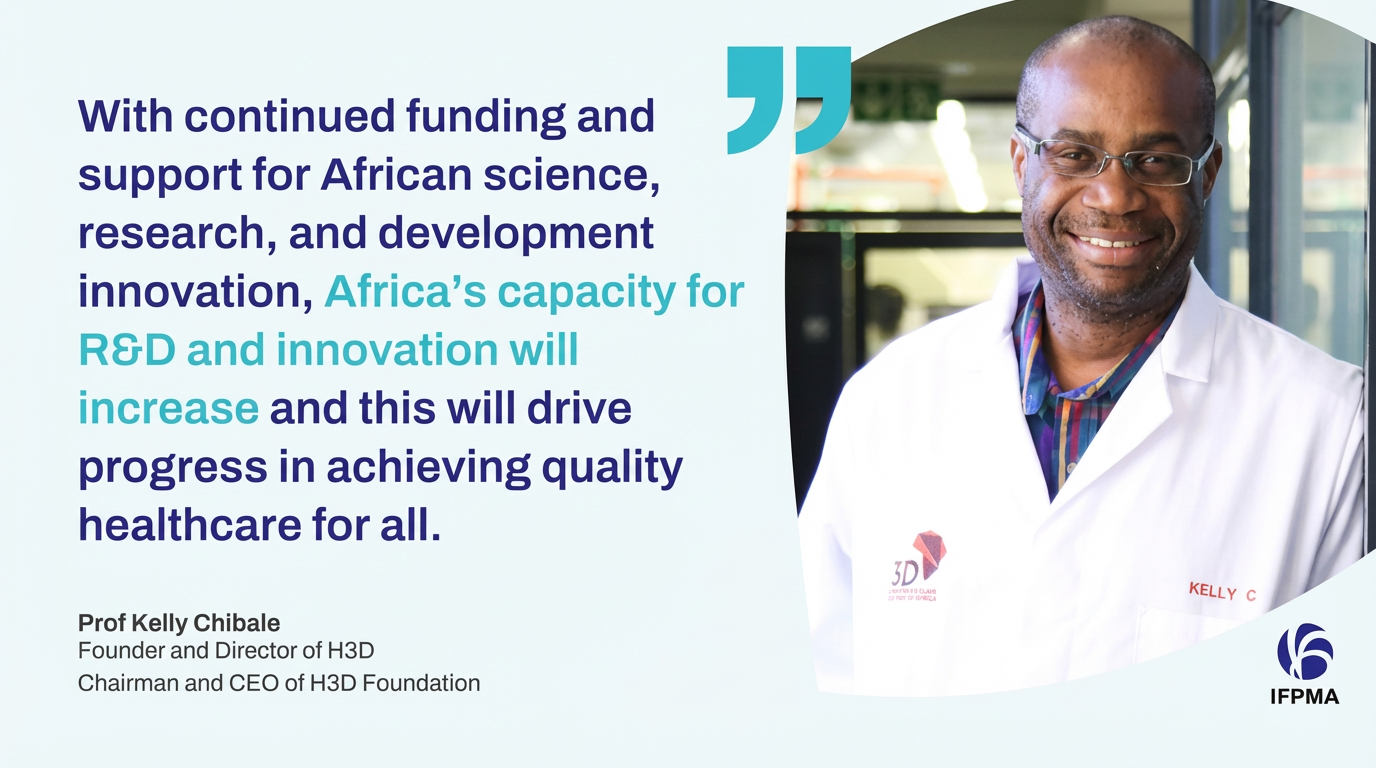
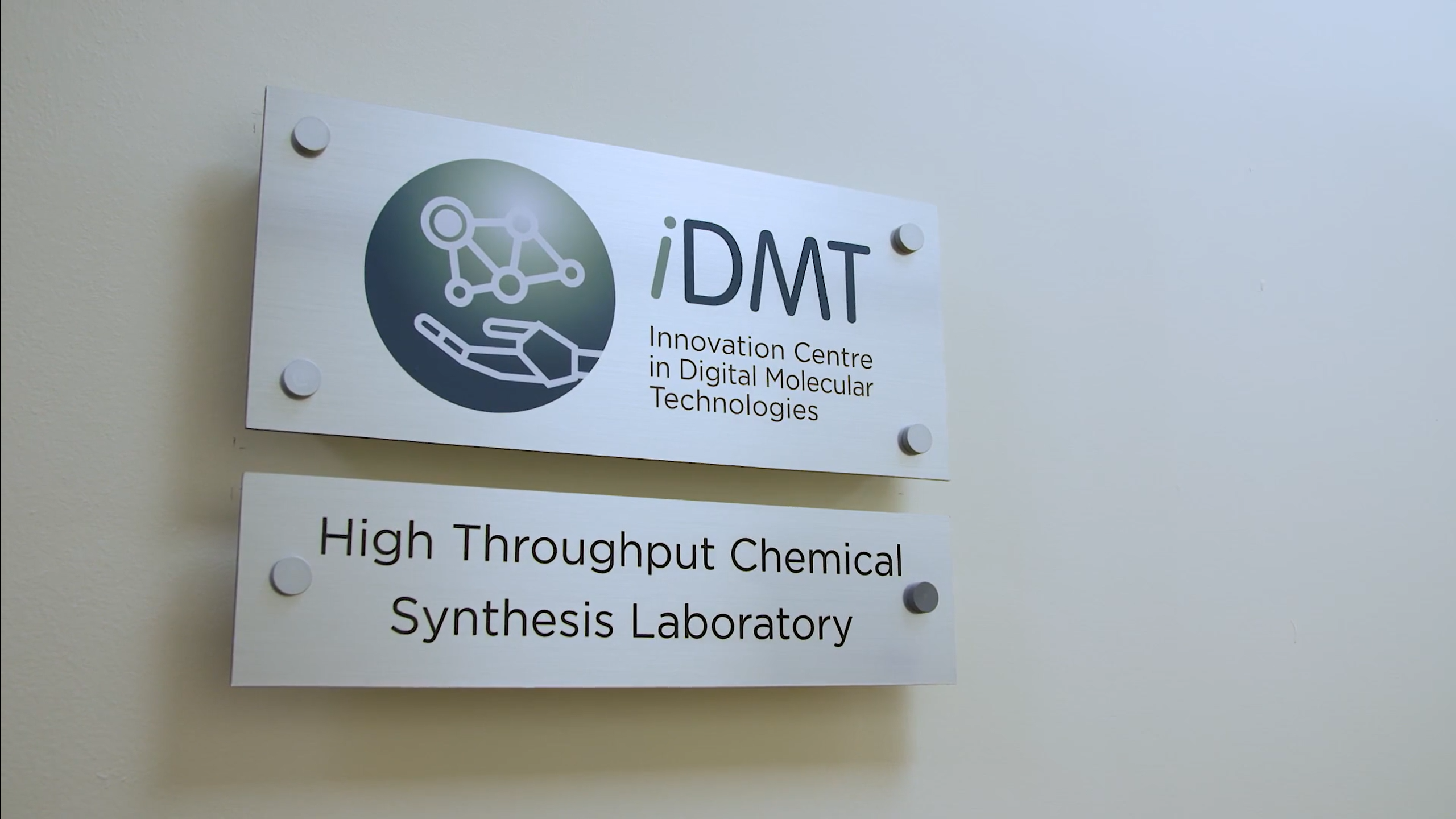
- Bioactivity and drug screening: ZairaChem-powered QSAR training and bioactivity prediction, plus a multi-endpoint ADMET profiler covering solubility, toxicity, and the H3D Centre's malaria/tuberculosis screening cascades.
- Quantum-computing-assisted folding: a CVaR-optimized Variational Quantum Eigensolver (via QuPepFold) for peptide ground-state energies, and a quantum-walk-inspired Metropolis simulation (inspired by the QFold algorithm) that produces full 3D backbone trajectories -- runnable with zero extra dependencies.
- Spatial digital twins: direct export of any structure to OpenUSD, ready for NVIDIA Omniverse, NanoVer VR, Unreal, Unity, UNIGINE, or UEFN.
- Gamification tools:
generate_game_designturns any scientific result into a deterministic set of levels, par scores, and achievements;generate_multiplayer_challengeturns one into a round-based competitive structure with a real-metric objective and team roles -- ready to drop into a live arena. - Digital twins of real facilities:
generate_facility_twinbuilds walkable, instrumented digital twins of a biomining reactor, a MEOR oil-recovery reservoir, a pipeline corrosion-monitoring rig, a quantum lab station, or an ADMET screening lab -- with every gauge and indicator light driven by the actual computed output of the corresponding science tool. - UWI translation:
uwi_spawn_objectanduwi_apply_graphtranslate a scene description into the exact tool calls needed on Unity, Unreal, UNIGINE, or any of the three UEFN backends.
The claude-skills plugin packages qFoldIT's domain expertise as modular, reusable Agent Skills:
- Scientific simulation: quantum molecular folding, NVIDIA BioNeMo-powered structure prediction, a validated VQE simulator, bio-mining and ore-prospecting kinetics, microbial enhanced oil recovery, pipeline corrosion modeling, plant growth and L-system procedural botany, and plastic pyrolysis characterization.
- VR science: a NanoVer bridge for collaborative, interactive molecular dynamics in virtual reality.
- Digital twin and engine skills: a shared UAG pipeline feeding dedicated adapters for Unreal Engine, Unity, UNIGINE, OpenUSD/NVIDIA Omniverse, Apple RealityKit/visionOS, Three.js/WebXR, and -- the flagship multiplayer connector -- UEFN/Fortnite, with a facility-twin builder purpose-built for turning labs and industrial sites into playable spaces.
- Molecular Tetris: a genuinely playable, browser-based science game already shipping today.
qFoldIT connects to Fortnite through three distinct, community-built MCP bridges, each opening different capabilities:
- KirChuvakov/uefn-mcp-server (MIT) -- a lightweight 28-tool bridge for fast, permissively-licensed scene control.
- undergroundrap/UEFN-TOOLBELT (AGPL-3.0) -- 358 tools across 55 categories, complete with its own native MCP bridge, a scan of the full 4,698-device Fortnite Creative palette, and the ecosystem's most powerful capability: generating and deploying real Verse gameplay code directly from a placed scene.
- quangdang46/uefn-verse-mcp (AGPL-3.0, building on both of the above) -- an MCP-first architecture with a broad registered-action surface.
Fortnite's own official Industrial Galleries and Industrial Prefabs content categories -- Factory, Power Plant, The Rig, Junk Junction, Steel Bridge, and more -- give qFoldIT's facility twins real, ready-to-use architectural building blocks, and Verse's own creative_prop/creative_device classes give every generated instrument a real, confirmed mechanism for coming alive in a live session.
scientific-world-schema is qFoldIT's standalone specification repository -- the single source of truth for SOS, SKG, SEM, UAG, and UWI, so every domain-specific MCP and every engine skill in the ecosystem speaks the same language.
qFoldIT's roadmap is built directly on top of what's already working:
- A fully realized UWI, extending today's translation layer into deep, native integrations across every major engine and lab-hardware platform -- Blender, LabVIEW, ROS2, NI DAQ, and physical sensor networks -- so any scientific object can be spawned, measured, and streamed live, anywhere.
- Persistent, community-driven seasons: since every qFoldIT game-design document carries a deterministic seed tied to its source result, a growing Scientific Knowledge Graph of community-contributed discoveries can unlock new zones, challenges, and content over time -- turning ongoing scientific work into an ongoing, shared world.
- Boss fights as real optimization problems: live quantum simulations and folding trajectories driving actual in-game encounters, where beating the boss means genuinely converging the computation.
- AI Scientist NPCs: agents that hand out quest chains mirroring the real scientific method -- hypothesis, experiment, measurement, knowledge -- turning good research practice into core gameplay.
- Secondary-structure-driven procedural architecture: real protein secondary-structure classifications (alpha helices, beta sheets, turns) generating level geometry directly, so a folded protein's own shape becomes a piece of playable space.
- A complete, end-to-end multiplayer proof point: taking a live scientific result all the way from computation to a published, multiplayer-tested Fortnite experience -- the natural next milestone for a platform built on the idea that science is better, and reaches further, when it's shared.
qFoldIT's layered architecture -- SOS, SKG, SEM, UAG, UWI, and MCP, now joined by a direct UEFN-TOOLBELT integration -- means every one of these next steps builds on infrastructure that already exists and already works. The foundation is real; the destination is a genuinely multiplayer, genuinely scientific, genuinely playable universe.
qFoldIT's presence in UEFN isn't only architectural -- the organization holds a live UEFN Team account, "qFoldIT," tagged with its own mission statement, "Scientific Gamification," ready to develop and publish island projects, share them via Unreal Revision Control, and grow its contributor roster (up to 30 team members) as the ecosystem's Fortnite work moves from integration to publication.
- qfoldit/Protein-Design-MCP -- the MCP server: 30 tools spanning generative design, physics-grade scoring, quantum folding, gamification, digital twins, and engine control.
- qfoldit/skills -- 23 Claude Skills covering scientific simulation, VR science, and digital-twin engine adapters for every major platform.
- qfoldit/scientific-world-schema -- the canonical SOS/SKG/SEM/UAG/UWI specification tying the whole ecosystem together.














An open-science partner of the Ersilia Open Source Initiative and Visualizing biological data




GitHub Organization:


